
SBC BOOKKEEPING & CONSULTING
Marketing Partner Evaluation & Strategic Recommendation
Independent Consulting Engagement | Summer 2026
Role: Marketing Partner Evaluation & Market Intelligence Analyst
The Challenge
SBC leadership faced an ambiguous strategic decision: determining which marketing alternative was best positioned to support the company's growth objectives while balancing strategic fit, execution capability, market knowledge, measurement, operational capacity, and implementation risk.
The objective was not simply to compare vendors. It was to create a consistent, evidence-backed decision process capable of supporting an executive recommendation.

The Approach
01 | Structure the Decision
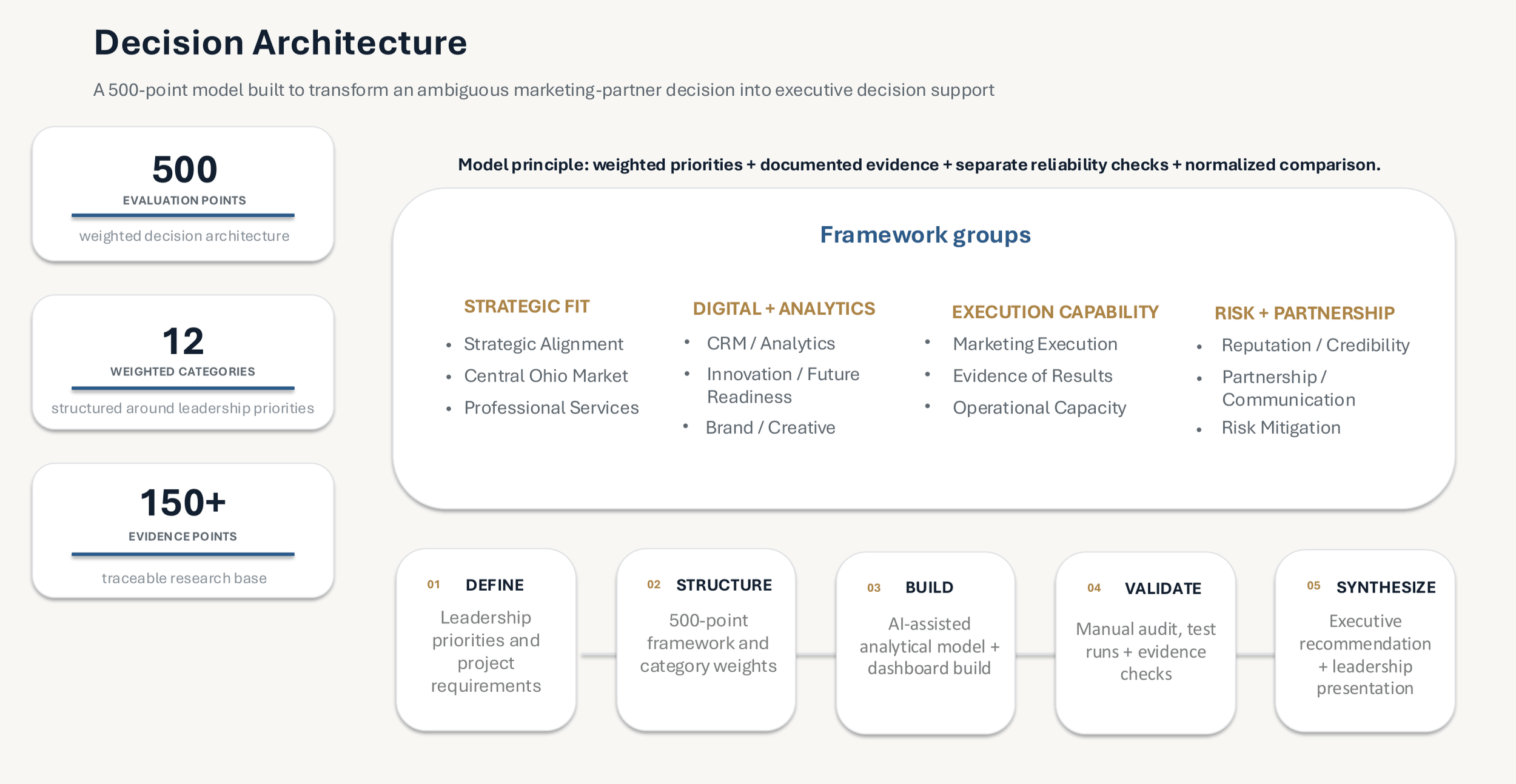
Translated leadership priorities and project requirements into a 500-point evaluation framework across 12 weighted categories, assigning greater influence to factors most consequential to SBC's objectives.
02 | Build the Evidence Base
Conducted market, competitive, company, and capability due diligence and organized the research into a structured evidence library.
The final analytical system contained 150+ documented evidence points, creating traceability between research and evaluation.
03 | Develop the Analytical Model
Built an Excel-based decision model connecting:
Strategic Priorities → Weighted Categories → Evaluation Criteria → Supporting Evidence → Scoring → Comparative Results
Category performance was normalized to support consistent interpretation across criteria carrying different strategic weights.
04 | Analyze Tradeoffs & Risk
Moved beyond aggregate scores to identify the factors actually driving differences between alternatives.
Quantitative findings were considered alongside strategic fit, qualitative evidence, implementation risk, and business judgment rather than allowing a single score to determine the recommendation.
05 | Recommend to Leadership
Synthesized the analysis into an executive recommendation incorporating findings, risks, validation requirements, implementation considerations, and next steps.
The methodology and recommendation were then presented directly to SBC leadership.
Deliverables
Strategic Evaluation Framework
500-point weighted decision architecture
Evidence Library
Structured documentation supporting evaluation decisions
Analytical Decision Model
Excel-based weighted scoring and comparative analysis
Executive Dashboard
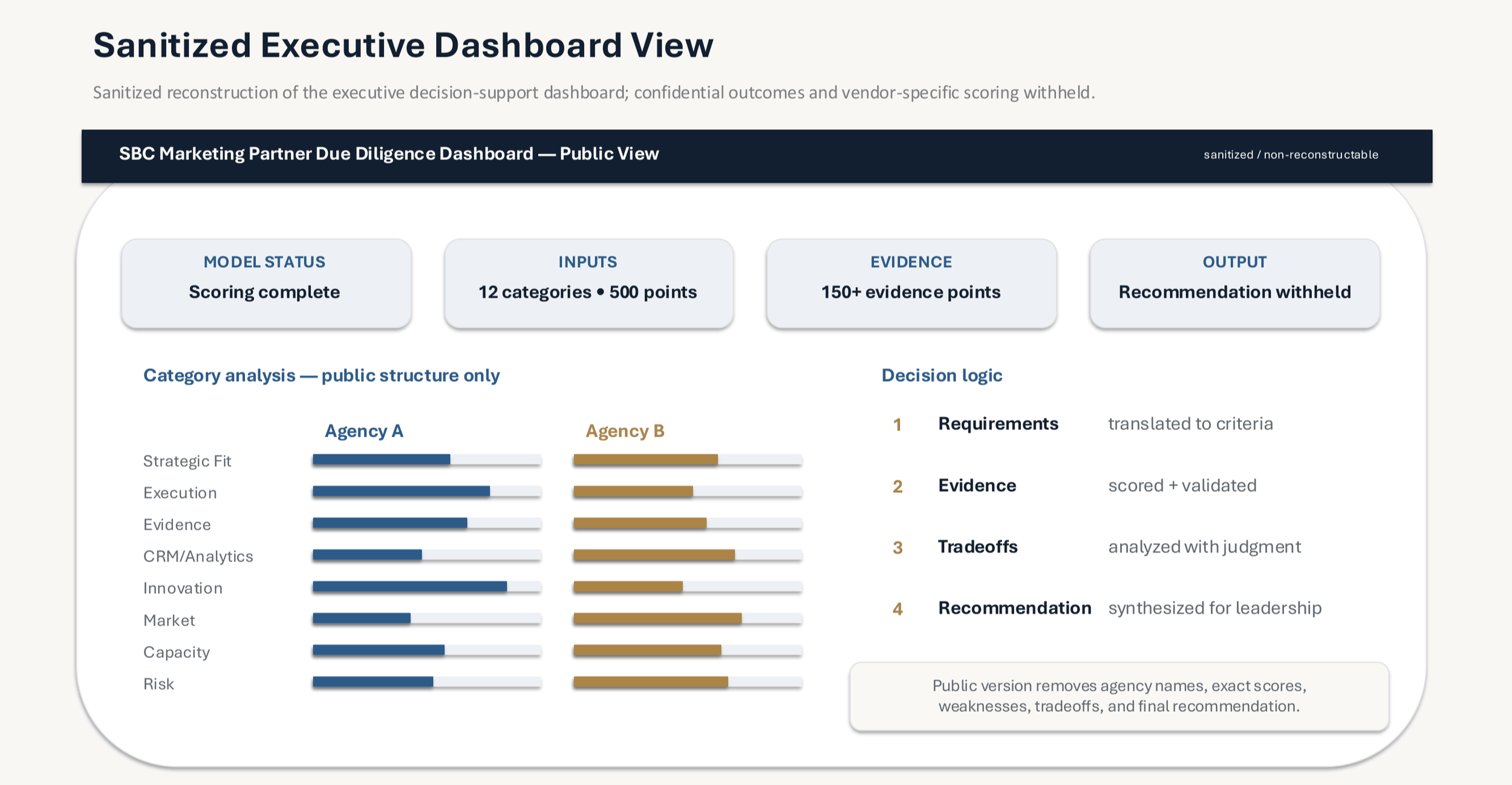
Visual synthesis of overall and category-level findings
Tradeoff & Risk Analysis
Identification of decision drivers, risks, and strategic considerations
Executive Recommendation Report
Synthesis of findings, conditions, and next steps
Leadership Presentation & Q&A
Presentation of methodology and recommendation directly to company leadership
By the Numbers
150+ documented evidence points
12 weighted evaluation categories
500 total evaluation points
2 finalists evaluated
1 executive recommendation
The Outcome
From an ambiguous strategic question to a structured, evidence-based executive recommendation.
The engagement gave leadership a consistent methodology for comparing strategic alternatives while making the underlying evidence, tradeoffs, uncertainties, and risks visible within the decision process.
Capabilities Demonstrated
Structured Problem Solving • Market Intelligence • Competitive Analysis • Due Diligence • Excel • Quantitative Decision Modeling • Business Judgment • Executive Communication • AI-Assisted Development
Confidentiality
Selected project materials are sanitized for public use. Vendor identities, individual scores, client financial information, proprietary information, detailed weaknesses, and the final recommendation are omitted or anonymized.
SBC BOOKKEEPING & CONSULTING
Marketing Partner Evaluation & Strategic Recommendation
Independent Consulting Engagement | Summer 2026
Role: Marketing Partner Evaluation & Market Intelligence Analyst
The Challenge
SBC leadership faced an ambiguous strategic decision: determining which marketing alternative was best positioned to support the company's growth objectives while balancing strategic fit, execution capability, market knowledge, measurement, operational capacity, and implementation risk.
The objective was not simply to compare vendors. It was to create a consistent, evidence-backed decision process capable of supporting an executive recommendation.
The Approach
01 | Structure the Decision
Translated leadership priorities and project requirements into a 500-point evaluation framework across 12 weighted categories, assigning greater influence to factors most consequential to SBC's objectives.
02 | Build the Evidence Base
Conducted market, competitive, company, and capability due diligence and organized the research into a structured evidence library.
The final analytical system contained 150+ documented evidence points, creating traceability between research and evaluation.
03 | Develop the Analytical Model
Built an Excel-based decision model connecting:
Strategic Priorities → Weighted Categories → Evaluation Criteria → Supporting Evidence → Scoring → Comparative Results
Category performance was normalized to support consistent interpretation across criteria carrying different strategic weights.
04 | Analyze Tradeoffs & Risk
Moved beyond aggregate scores to identify the factors actually driving differences between alternatives.
Quantitative findings were considered alongside strategic fit, qualitative evidence, implementation risk, and business judgment rather than allowing a single score to determine the recommendation.
05 | Recommend to Leadership
Synthesized the analysis into an executive recommendation incorporating findings, risks, validation requirements, implementation considerations, and next steps.
The methodology and recommendation were then presented directly to SBC leadership.
Deliverables
Strategic Evaluation Framework
500-point weighted decision architecture
Evidence Library
Structured documentation supporting evaluation decisions
Analytical Decision Model
Excel-based weighted scoring and comparative analysis
Executive Dashboard
Visual synthesis of overall and category-level findings
Tradeoff & Risk Analysis
Identification of decision drivers, risks, and strategic considerations
Executive Recommendation Report
Synthesis of findings, conditions, and next steps
Leadership Presentation & Q&A
Presentation of methodology and recommendation directly to company leadership
By the Numbers
150+ documented evidence points
12 weighted evaluation categories
500 total evaluation points
2 finalists evaluated
1 executive recommendation
The Outcome
From an ambiguous strategic question to a structured, evidence-based executive recommendation.
The engagement gave leadership a consistent methodology for comparing strategic alternatives while making the underlying evidence, tradeoffs, uncertainties, and risks visible within the decision process.
Capabilities Demonstrated
Structured Problem Solving • Market Intelligence • Competitive Analysis • Due Diligence • Excel • Quantitative Decision Modeling • Business Judgment • Executive Communication • AI-Assisted Development
Confidentiality
Selected project materials are sanitized for public use. Vendor identities, individual scores, client financial information, proprietary information, detailed weaknesses, and the final recommendation are omitted or anonymized.